Tuesday, June 26, 2012

A slice of Paris-- à la mode


 A few days ago Sylviane at the Guerlain cosmetic counter reminded me of what I should be about this morning. On July 10 my family and I will be boarding a plane for Paris and my plan was to review what little French I know before then, particularly the polite phrases. (Ignorance is more palatable if spread liberally with grace and humility, I’ve found, in a non-English-speaking country.) So until the particulars of my daily routine went awry, I had been spending 30 minutes a day with Pimsleur’s tapes, about as basic as one can get.

I thought I was doing well. Bonjour. Au revoir. Comment allez vous? Ou est la rue Saint Jacques? You know the drill. Sylviane has been in the states for 35 years, and has lived in the south much of that time, but it has not slowed her Parisian accent one millisecond. I could barely manage to understand her English, and certainly if I had tried my French, she may have doubled over laughing. I simply smiled a lot as I listened to her rapid history of the special orchids grown in China, three strains from which a hybrid was developed... for the delicious-smelling, exquisite-looking, too-pricey face and throat cream called  Orchide Imperial.

This morning, I was still thinking Paris, but I was cutting zinnias for my son’s family from my garden. The bed surrounds a cedar tree transplanted from the woods of my oldest sister, the same one who gave me seeds for the old timey multi-colored zinnias. A certain panic set in: my son is just out of the hospital and needs special care; each day I go by Whole Foods and pick up something nutritious to prepare for his lunch. I haven’t practiced my polite French phrases; but most of all, I haven’t given much thought to the reading I’m supposed to do in preparation for the writing residency I’ll be attending with Spalding University, my alma mater for the MFA in Writing.

As if to intensify my alarm as my husband can sometimes do with his morning pronouncements, he said entering the kitchen for coffee, “Know how many days it is until we leave for Paris?”

Ah, did I ever know. Three weeks, two days until flight time.

Panic and packing will wait. Here’s what I’d like to know. I’ve decided to blog for WELD from Paris if I can determine what readers might like to hear about: architecture; art museums; my workshop in Creative Nonfiction; food; my ekphrastic poetry project with my eighteen year-old grandson, Nicholas, who will be taking this trip before heading off to study architecture at Syracuse this fall, or simply the weather??

That last topic sounds facetious but I’m serious. One of the mentors at Spalding, Ellie Bryant, who incidentally will be leading my CNF workshop, has an exercise for her students much like a diary entry for the day. She calls it the Weather Journal project. One of my good friends Edie Hemingway allowed me to read the journal entries which she kept during a crisis in her family. I was very touched by the simplicity and profundity of her manuscript—all of which emanated from faithfully recording her “weather journal.”

Another avenue of discussion might be books. Preparatory and requisite reading for my workshop includes THE GREATER JOURNEY  Americans in Paris by David McCullough. McCullough contends that not all explorers went west. He writes of the earliest American “explorers” to visit Paris in the 1830s. Another required reading is A MOVEABLE FEAST (the Restored Version) by Hemingway.

Perhaps some readers know these books and have thoughts to share. I’d like to hear if you have a particular interest in what news I send back home during those three weeks.

À bientôt.

Tuesday, April 10, 2012

Three Reactions to Three Chance Encounters


Three Reactions to Three Chance Encounters
                                     -Kathleen Thompson

Dear Mr. Stafford
in lieu of a fan letter

Dear—
it begins smoothly enough
for you are dear—Sara agreed
after reading Passwords
and she is never wrong—
but how would it end?

If there were a letter
posted here in Charleston,
it would be laced with ironies:
my stumbling upon your “Bess”
the day after I drafted my “Sharon.”

The letter might rip open a tender spot
sealed up by time’s envelope,
of watching baseball and Buddy’s
signs to the catcher, his fingers
held just so, fingers I had touched
in a thousand young dreams.
That year I mailed a valentine
unsigned. My face flushed hot
as he began to wave
in front of the crowd
until the blonde behind me
stood up, returning his wave,
as smug as a shortstop
who has stolen three bases.

Or the day I stood in a line
longer than the busiest one
at any P.O. in Birmingham
to get Mr. Styron to sign.
To try and lift his darkness
I echoed his very words,
I have felt the winds
of the wings of madness
but he only glanced up
from where he sat,
slammed the book shut
on his pinched name,
silent except for rage—
or was it disdain—
pooling
in the hollows
of his eyes.

So, Mr. Stafford,
how will this end?
You might think it queer
for one so new to poetry
to sign sincere or true;
friend might be too bold
and love would surely
make you laugh.

You smile as I leave
from my front row seat.
The risk is too great:

There’s Mrs. Stafford.*
Perhaps she would be kind
enough to pass along
a few lines?

* I handed an earlier version of this poem to Mrs. William Stafford at a writers’ conference in Charleston in the ‘90s. I told her that two women from Savannah were in love with her husband and his work. She laughed with me, and said, “Just two? They’re everywhere.” The next morning Mr. Stafford and I were in the book room at the same time. Across the table he said very gently, “I like your baseball player.”

#

Close, But No Cigar: What I Would Write If I Were A Billy Collins
on the occasion of dinner with the Charleston poets and Billy Collins before his reading, late 90s

I would not write of calendars
or snow or foul winds that blow
away hats and people, not sonnets or haikus
or villaparadelles but this disease I have,
congenital, foot-in-mouth, faux pas’s, very plural—
those I would write over, make funny if I could.

I would eat my first short story, its green
pastoral setting as bland as the shepherd’s promises,
instead of sending it out to the New Yorker.
I probably could laugh about that blind date;
I would not say to Jane Smith that he kissed
like a cow at the drive-in. I would check
for a recorder under the seat, all around,
everywhere; I would strain harder to think
of something more glib to say to William Styron
than his quote about the wings of madness.

I’d laugh about jotting down a name
for Collins, so sure of myself,
about where Trip taught school, so smug
that I, myself might have been mistaken as the visiting
poet that night, rubbing elbows with writers at Zebo’s,
secure that mine was the tangiest balsamic vinaigrette,
one my lesser could only hope to taste.

I’d double over
at what Collins must have thought
when he fingered inside the left pocket of his jacket,
you know the one, for my card, proclaiming who I am,
to hear him read from its back, in my eloquent hand,
Trip Franklin, teacher, Montgomery Academy,
to see the headmaster’s knitted brow, puzzling
over one whom the librarian guessed might teach
at their near-unspeakable rival, Trinity Presbyterian.
(I try to placate myself. Trip was in the same town.)

Given the chance,
I’d rather run, hell-bent like some hyena,
relentless bloodhound, streaking
through a pasture of fresh cow piles,
then scrape my soles
onto my pristine carpet,
grinding the smell
into its weft and woof—
than to admit tripping again
red-faced, about this teacher
friend of my son’s
and his whereabouts.

Will mistakes matter at all, though, I muse—
by the time the new millennium poem is finished?
I wish a word were dead when it is said
and what it might purport, for such an epic
as life hardly merits a footnote about fools,
and I wish I were going west in a box
with Joe Priskulnick who probably killed himself
(before Eavan Boland* could in the poem)
deeming stupidity of such magnitude,
like mine, truly terminal.


*At the time of this reading noted poets were composing a millennium poem on Amazon. Collins had been invited to submit lines.

#

What Of Us?
Sentimentally I am disposed to harmony,
but organically, I am incapable of a tune.
                        - Charles Lamb
                        “A Chapter on Ears” Essays of Elia (1823)

written on the occasion of meeting W. S. Merwin
at Spalding University, Friday November 17, 2006

Yes what of us Mr. Merwin
Those who try but have no ear
Or at best appear tone deaf

You’ve implied only singers
Born with the musical gift or
Trained should attempt poetry

Could your verse hit the high notes
Without a cacophony of the inspired
If raucous behind you tuning up?

And what about you now writhing
About your dead black dog wondering
Whether Louis Simpson is sentimental

In the latest Hudson Review
You asked me if it was good
What could I say so I quoted

Frost’s discursion on tears their
Import for both reader and writer
But what I wanted to say is this:

When dogs of death come sniffing
Close enough for us to feel fear
Curling up into our very nostrils

The finer points of any scale
Become moot as we fend off snarls
We sing “Chamber Music” Old Ben
In whatever chord or key we can.

#

Tuesday, February 7, 2012

Outtakes: The Romantic Rotarian

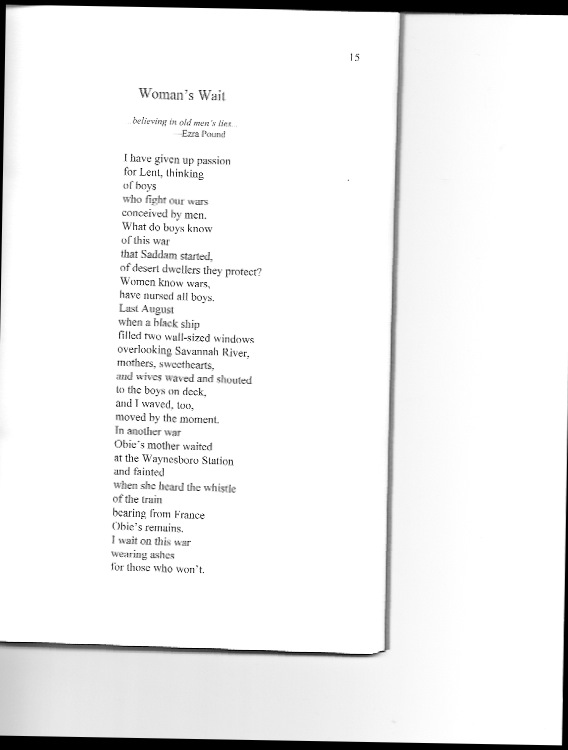
"Woman's Wait" was published first in WHEN THE WIND STOPS, a collection of Desert Storm Poems by Laura Sargent, 1991. The windows in this poem are at the Hyatt, River Street Savannah, where Rotary West still meets on Wednesdays.

Emma Kelly was dubbed the Lady of 6,000 songs by Johnny Mercer. She was a beloved pianist/vocalist who was famous even before her inclusion in John Berendt's infamous tale of Savannah, THE BOOK. She regularly performed for Rotary district meetings.

My poetry notebook from sixth grade, 1954-55.
Writing this essay for WELD has dredged up all sorts of things. Here are a few images I've unearthed.

Thursday, January 12, 2012

Hope is a thing with feathers...the bird that keeps us warm

Belated new year's greetings to all, and may I say, I'm with Emily Dickinson and Mark Kelly on hope and predictions. (Why bother with despair in predictions?) My predictions were nothing but hope, (except one--a gold star if you can figure out which one) and since they were caught up in cyberspace between here and Orlando where I hurriedly penned them, I thought I'd catch up with the 2012 crowd, and record mine for posterity since my first prediction/hope has already come to fruition.

To wit: Be not faint of heart, oh, my young and foolish readers, for you have come to the source:  heed these wise (or wizened? ) predictions for 2012.


  • The University of Alabama will win the national championship football game in January. My source, my son, is infallible.
  • The whole world will adopt the advice of Mickey Mouse and imagine a world in which they will believe in their dreams.
  • My essays in WELD will be nominated and win a Pulitzer Prize.
  • Disney World will develop a turkey which has four legs before the next Christmas season.
  • My novel will be accepted for publication by a NY publisher and the contract for movie rights will include a stipulation that Meryl Streep star as the protagonist.
  • Disney World will develop a Line Breaker Detector which will eject any such dastardly person the moment his right forefinger prints register as he enters a given theme park.
  • My linked stories will have one story selected for Best Stories of 2012.
  • Disney already has magical (and cost prohibitive) umbrellas and ponchos that *poof* appear on every corner at the first drop of rain, but  in 2012 will introduce the giant instantly inflatable bubble which will shield each theme park from inclement weather. You’ll only be charged on the days it is used. Consult your almanac (or James Spann) prior to planning those vacation days.
  • A small press publisher will offer me an unheard-of (outside of the Canadian queen of stories, Alice Munro) advance to publish my thesis collection of stories.
  • The verities of “it’s a a small world” will be realized by all world leaders, and this year will be the happiest cruise that ever sailed as the orchestra for world peace fills our ears with harmony. 
Hakuna matata.

Sunday, December 11, 2011

Four-Pie Day: What FB Pics Can't Say

I became Gran the Cooker before Nicholas, my oldest grandson, was in first grade. Almost as soon as he could talk, he could instruct any babysitter on how to cook his favorite food, “noodles and chumchum cheese.”  In first grade when I gave a lesson to his class at St. Francis Xavier on writing poetry, and assisted them in writing a poem as a group, I knew that he had me forever characterized. The class, with assistance from their astute teacher, Miss Evans, married now but still teaching first grade there, sent me a poster-sized thank-you note in the form of a poem.

GRAN

Gran is nice
She likes brown rice.
Gran is silly
She likes chili.
Gran is great.
She likes to bake.
Gran is smart.
She has love in her
HEART.

The poster decorated by the class is covered with so many colorful hearts, bowls, butterflies and other crayon markings that you can sometimes hardly see the words. Joy. Joy. I said, “How did they know all this, Nicholas?”  “They asked me,” he replied. No wonder it has become a tradition for me to ask Nicholas what he’d like me to bake on his birthday. This Wednesday he turned eighteen, and his choice was the same as last year: a key lime cheesecake.

I have five cheesecake pans in my kitchen, but I chose a nearly new nine-inch one last Wednesday. As the cheesecake cooked, butter leaked from its generous graham cracker crust onto the bottom of the oven. A cheesecake pan is a springform pan, and truly it defies logic that any one of them wouldn’t leak. I learned early on from my eager-beaver algebra grad student who couldn’t teach you to tie your shoes that the circle is the only shape that will not fall through itself; thus, the circular man hole cover. (The singular thing I learned from him.) And I might add, thus, the cheesecake pan, for the bottom must fit securely into the sides.  A spring clip fastener tightens and holds the sides firmly in place.

High temperatures and butter don’t mix. Duh. This is not an algebraic equation or geometric theorem that I know of, but it is a Kathleen proverb. When I took the cheesecake out to top it with the final layer of sweetened and vanilla-flavored sour cream, I had to change the temperature to 500 degrees for just a few minutes. I knew there might be a problem because there was already smoke. Where there is smoke there is fire, right? When I removed the cheesecake after a few minutes, almost seconds, just to get the sour cream bubbling at the edges, the smoking was terrible. I threw open doors and turned on fans. The self-cleaning process, it seemed to me, was the logical next step. After all, it is the baking season, and I would need that oven immediately. I pushed the appropriate buttons, but within, I’d say, ten minutes, flames were leaping up inside my oven. My gut reaction was to grab the red fire extinguisher from underneath the stovetop. There it sat, unused, with the clip ready to be pulled. I tried the oven door but it didn’t open. Thank God. The microwave above also gave me a digital sign when I tried that door handle: The oven is locked. Meantime, my heart is into Olympic track-running speed, as I dial my husband at work, keeping an eye on the flames. (Once I dialed him long distance at 11:00 p.m. in Greenville, SC, from Prattville, AL, to ask him about a teenage issue, an emergency I judged, that was occurring at the moment.) “Don’t open the door!” he almost shouted.

Turns out, he says, that the temperature inside the oven is probably up to 600 degrees while cleaning but the flames could be as hot as 1500 degrees. (His engineering specialty is thermodynamics, and he helped save Skylab, the first space station, by working to design the now-famous heat shield.) Oh, boy. My oven was going to go up in flames and my house, too. Just as I was about to hang up and call 911, another digital message popped up. Oven disabled. The flames began to subside.  When I reported that to Papa the Professor, he assured me that the oven had a safety mechanism that kept the door locked and probably had an appropriate cut-off device. With his close supervision the next morning, we “burned the BTU’s left in the butter” by using normal baking temperatures. Horrid smell. Ghastly smoke for a bit. Ah, but then his troubleshooting expertise was satisfied; I could again try the self-cleaning process.

I’m happy to report all is well with my temporarily ailing oven. It has that nice blue interior again and, more importantly, it has baked with fair success four pies although the baking was not even, and I did have to shift the pies once. This is excellent news. Victoria, my only granddaughter, turns nine tomorrow.  I wonder what chocolate thing she’ll want me to bake?
Pecan
3--from Glenwood's Pecans sold locally
Pear Mincemeat
 Remember when I canned it earlier this fall?

Wednesday, November 23, 2011

The Efficacy of Industry: Whatever Works

As a rule, I hate jokes. Perhaps it's because I'm not a good joke teller, or perhaps I'm not a good joke teller because I hate jokes. I don't know which. In any case, I'm about to break the rule.

Two friends who worked on the assembly line for a car parts plant in Tuscaloosa died. One went straight to heaven; the other, straight to hell. After a few weeks the one in heaven telephoned the one in hell and said, "Hey, buddy. Howya doin down there?"

"Oh, purty good, I guess," replied the one in hell.

"Purty good? Whaddaya mean?" said the one in heaven.

"Well, we have to work all the time, but it's not bad. We get breaks any time we need 'em, smoke breaks, long lunch breaks, you know...by the way, I've always wondered, what's it like up there?"

"Not good. Not good at all. We work long days and nights and can't even get a single break. It's just work, work, work," said the guy in heaven.

The guy in hell was very puzzled. "Why do you think that is?"

"Not enough help," said the guy in heaven.

Probably the real reason I remember this joke and not the other two my nephew, Gary (who BTW works on an assembly line), told this past weekend is that I like the underlying metaphor of  this one, that the afterlife may not be too different from our lives on earth.

Without getting into a diatribe on my religious views, I will simply say that during this Thanksgiving week, one of my blessings is work. Not all work, mind you. Don't put me on an assembly line, for that would be sheer hell on earth. But the work I love: being in the kitchen with my sisters making cornbread dressing or Cranberry Conserve; ironing in the early morning when no one in the house is awake but me;
writing a poem or essay about my work, blogging...

(See yesterday's prep work for Thanksgiving below.)

The ironing takes me back to the late fifties when it was my after-school job to iron for my sister all the starched cottons she had. The starch was not from a can, but the stiff kind, the kind that you mixed with water, dipped the clothes in it, wrung them out, hung them on the clothes line to dry, and sprinkled and kept in the refrigerator until ironing day. (Ann Taylor in Prattville held the record for this: she declared that once she left a sprinkled tablecloth in the refrigerator for two years.) I devoured the repetition of the nuances in "Guiding Light" and "As the World Turns" as I smoothed the wrinkles away and imagined what I might be doing in my own kitchen someday. The great difference is that I no longer watch soaps at the ironing board, but relish the quiet for just the imagining, or for remembering the days that are no more. Or philosophizing on the greater issues of life as I did this morning ironing Tommy's khakis.

I remembered when the sister six years older than I am, Gary's mother, told jokes. She still loves to hear a good one even though she can't walk from failed knee surgeries. She used to sing  incessantly as a teenager; too bad she was born too soon for American Idol. My oldest sister taught us both a lot about cooking. Now she can't remember the ingredients that comprise her red velvet cake. My only living brother loves to plant and grow things. Two bouts with pneumonia last winter have stripped him of most gardening.

Given the choice, I think I would take fingers and hands and arms and legs over wings. Streets of gold are not necessary. Just a plain house. With an ironing board and iron, of course. And grandchildren--that goes without saying. I know a lot of my friends hate ironing, so my choices wouldn't work for them. But I'll leave those little details up to God.
Equipment Ready

Cranberry Conserve Cooking


Cranberry Conserve Canned


Strawberry Salad, Ready to freeze


Friday, November 4, 2011

What's in a name?

I'm always interested in how an artistic rendering comes to be named. When I interviewed master weaver Clare Matthews for a profile in WELD http://www.weldbham.com/, I asked her  about the naming of her rugs/wall hangings.“I only name my pieces if they’re going to be in an exhibition or gallery. They insist on a title,  not Rug 40 or Rug 41. So sometimes I ask myself what does this remind me of?”

Clare and I met at a poetry reading in Leeds. The pattern of her published piece in Birmingham Arts Journal reminded her of the game Tiddledywinks; thus, its name.  “The way the little round pieces flip up in kind of half circles, and then they’re moving, and they come back down again. Always nice bright colors in shiny plastic.”


"Desert Dazzler" is easily recognizable at the WELD web site. It dances right before your eyes. "Rhythm and Blues" is also pictured there. Some of the out takes of the article I thought I'd post here for those who want to see more of the fun visit I had in Clare's home.
She is pictured in front of both her cool and warm colors. A portion of her wall of collected cards, the passementerie, the creel, and a circular table mat she freehanded after seeing a similar one in the American west are shown here.

The picture of Clare seated at her loom on the web site is much better than one I could take. See it at http://www.mattfinishfibers.com/.

Message in a Blog

  About twenty Birmingham language arts teachers endured my holding forth yesterday in my current gig as a Road Scholar ...